
Finding People in the Newington Residents Directory
There is no single official roster of everyone who lives in Newington. A property card identifies a taxable owner and parcel. A deed names parties to a recorded transaction. A voter route concerns eligible registered voters and has privacy controls. A historic directory or newspaper places a person at an address for a dated moment. Those differences matter when a search begins with a name but the answer needed is an address, or begins with a street but the answer needed is a family connection.
The most reliable search uses a short chain and labels each result by role. Start with Newington Property Record Cards when an address or owner name is known. Use the town's GIS map to check the parcel. Move to the Town Clerk when a volume/page or recorded instrument is needed. For an older person, the library, Connecticut State Library, newspaper, and directory shelves may be more useful than a current portal. A missing result can mean the wrong jurisdiction, a spelling difference, a privacy rule, or a portal gap.
- Write down the name, street, approximate year, or event that is already known. Keep the exact spelling and any middle initial.
- Search the assessor by owner, street number and name, MBL, unique identifier, or condominium complex. Treat the display as an owner and parcel lead, not proof of occupancy.
- Open the parcel in Newington GIS and save the parcel ID, map date, layers used, and any volume/page clue shown by the card.
- Use the Town Clerk's name-based land index for the deed, lien, map, or other recorded instrument. The grantor is the party conveying an interest; the grantee receives it.
- Choose the matching state, court, vital, library, archive, or request route. Preserve the source date and ask the custodian for an official copy when the distinction matters.
That workflow serves family research, reconnecting, house history, heir questions, and civic curiosity without pretending that one search result answers every question.
Newington's Resident Records Offices
Newington is in Hartford County, but Connecticut counties do not run a county recorder or county clerk for ordinary land records. The Newington Town Clerk is the local custodian for deeds, maps, vital records, trade names, licenses, permits, public notices, and other filings. The Assessor and GIS offices supply the parcel and location clues that make a name-indexed clerk search workable. Registrars of Voters and state agencies handle election information under separate rules.
Newington Town Clerk
200 Garfield Street
Newington, CT 06111
860-665-8545
GIS and Real Property Information
Town Offices Building
Newington, CT 06111
860-665-8500
Newington Registrars of Voters
Newington Town Offices
Newington, CT 06111
Use the official contact route
For court matters, Newington uses the New Britain Judicial District, while current probate matters use PD07, Newington Probate Court. Vital records have their own event, date, and eligibility rules. That office map prevents a common mistake: looking for a Hartford County deed counter that does not exist.
Newington Property Records by Parcel
The Property Record Cards portal is the strongest current address-to-owner starting point. Its search screen accepts several independent paths, so a researcher can begin with a street or a name and later switch to a stable parcel key. The sales tab adds date, price, acreage, design, rooms, area, year, and bath controls. The Newington Assessor page supplies the office and revaluation context. The assessor's visible owner field should be described as a taxable-owner display. It can support a search, but it does not certify that the person occupies the building now.
| Field | Form | Use in a Newington search |
|---|---|---|
| Owner Name | Text, last name first | Broad name lead; test spelling and initials |
| Street Number and Name | Text plus street list | Find a situs parcel along a named street |
| Unit | Text | Separate a unit or suite when the card supports one |
| MBL / Unique Identifier | Text | Repeat a parcel search with a stable local key |
| Property Use | Checkbox group | Filter residential, public, commercial, school, vacant, and other uses |
| Sales date, price, acres | From/To ranges | Review a sales lead without calling it a deed or market proof |
The Newington property search screen makes the fields visible before a query is run.
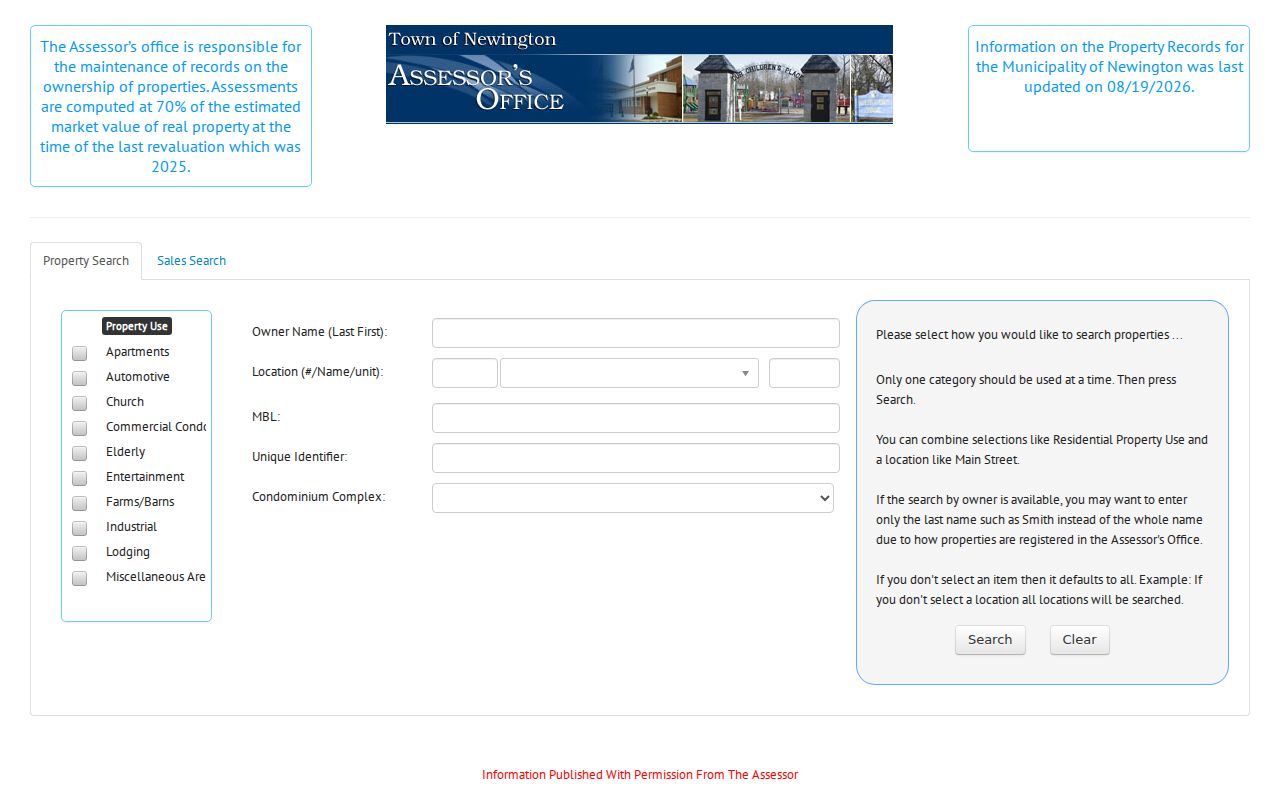
The field layout shows why a unique ID or MBL is more dependable for repeat work than a loose street phrase. Keep the map and card retrieval dates with the result.
From a Newington Address to Records
Newington's land-record computer index is organized by name, not by property location. The Town Clerk FAQ therefore points address researchers toward the Grand List or an assessor field card, where a volume/page reference can help narrow the deed search. That bridge is the practical heart of a Newington residents directory workflow: address to parcel, parcel to volume/page, volume/page to recorded parties.
Do not treat a sales-history row as the deed itself. Search the owner as grantee, inspect the purchase instrument, read the grantor, and then search that earlier party as grantee. Confirm the date, document type, legal description, and parcel or map reference at each step. The FAQ reports a computer index from 1976 forward, while the portal displayed Newington image availability from March 21, 1985. Earlier work may require the clerk's office, paper books, microfilm, or an archive.
- Parcel
- A mapped unit of land with a local identifier. It is the bridge between the assessor, GIS, and recorded documents.
- Index
- A finding aid that names a party or document. An index entry is not the full deed image.
- Volume and page
- The clerk's book reference that points to a recorded instrument or map.
- Criss-cross directory
- An address-to-name directory, usually historical. It can show a listed occupant, not necessarily a title holder.
Note: Newington's assessor and Town Clerk use different keys, so preserve both the unique ID and the volume/page reference.
Which Current Newington Directories Exist
A current Newington residents directory is best understood as a group of role-specific sources rather than a complete roster. The property card can show a taxable owner. The tax portal can supply an account lead. The voter route concerns registration and districts. The land index shows recorded parties. The library and newspaper sources are usually dated. No verified official town page publishes every resident, every occupant, or every household in one public list.
| Source | Role shown | Keeper | Access or limit |
|---|---|---|---|
| Property Record Cards | Taxable owner, parcel, value, sales and permit clues | Newington Assessor | Public card fields vary |
| Tax account search | Taxpayer, location, bill, unique ID, list number | Newington Tax Office | Account lead, not occupancy proof |
| Voter status or file | Registration status, district, legally releasable fields | Registrars / Secretary of the State | Privacy program and written-file rules |
| Town Clerk land index | Grantors, grantees, instruments, dates, volume/page | Newington Town Clerk | Name-based index; images and copies have separate rules |
| Historic directory or newspaper | Dated address, household, school, or event lead | Library, archive, or NARA | Year, page, and repository are required |
When the question shifts from a broad source map to one person's matching fields, the Newington resident lookup follows the same roles more closely. It does not turn a taxpayer, deed party, or directory listing into a current residence claim.
Newington Voter Records and District Clues
Newington's voter route is narrower than a street-wide people list. The town registrar page points to registration, district, address and name update information, while the state voter-information route explains how a full file is requested. The status path asks for the town, name, and date of birth through the current form. A full voter file requires a written request to the Secretary of the State, and the research records a $300 fee and a 2026 rule that releases only the year of birth, not the month and day.
Use the voter result to understand registration or district context, not to expose a protected address. Newington has seven voting districts, and the Street Listings by District PDF is the better source for deciding which ranges belong together. A status lookup and a district map answer different questions.
The Newington voter-status route shows the town, name, and date-of-birth prompt.
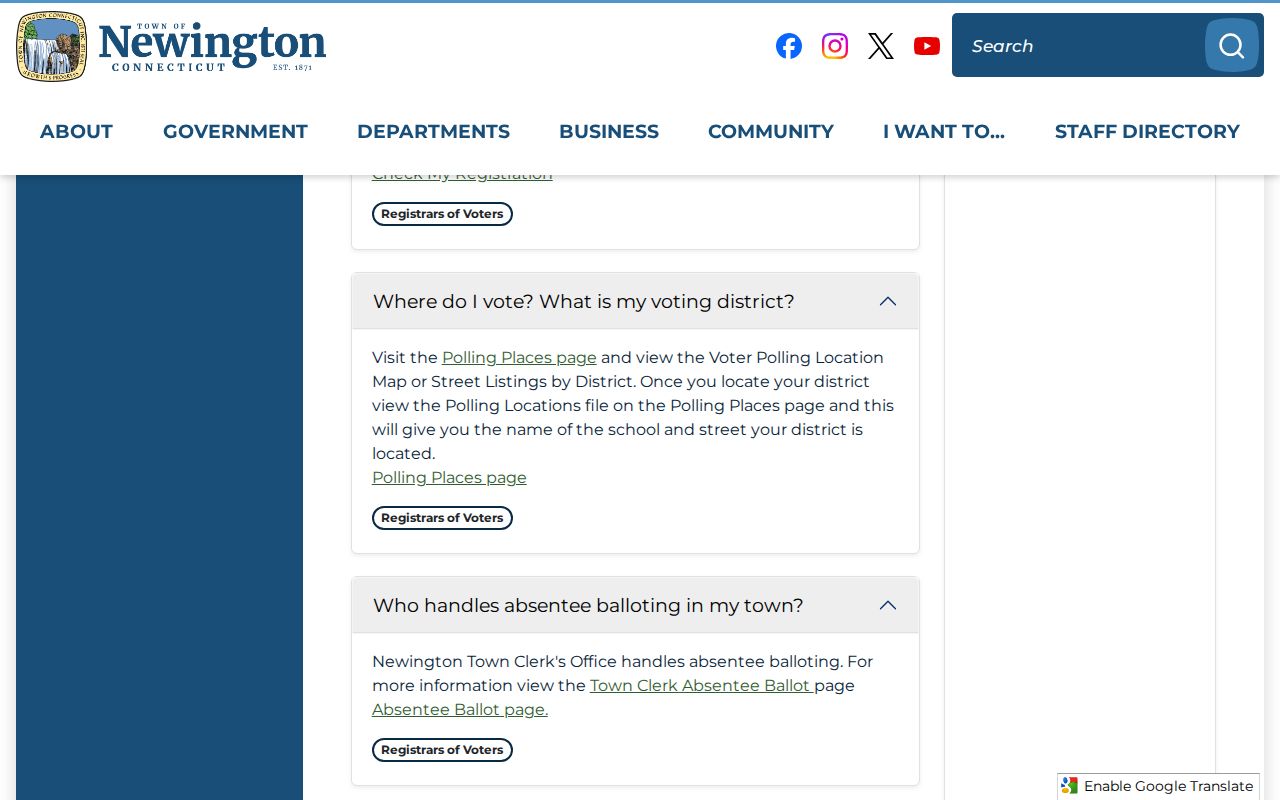
The screen is a registration lead. It should never be used to reconstruct a protected person's location from other public layers.
Note: The Voter Registry Privacy Program is separate from Safe at Home and can limit disclosure when safety requires it.
Newington Resident Vital Records
Vital research follows the event, not simply the person's last town. Newington local genealogical and vital information begins in 1871, the year of incorporation. Earlier local events may lead to Wethersfield. The Connecticut Department of Public Health statewide registry begins July 1, 1897, and local and state sources overlap without being interchangeable for every certificate request.
Newington can issue certified birth, marriage, death, and fetal-death records when the statutory registrar and location rules fit. Orders can go through the Town Clerk, mail forms, or the online Permitium route. A complete request may need the event details, parents or spouses, relationship, identity, contact details, payment, and signature. Birth records under 100 years are restricted. Death and marriage records have limits on Social Security and administrative fields.
For a local starting point, use the Newington online order portal. A town certified copy is listed at $20, while the online service adds separate card, verification, and delivery charges that should be checked at the time of order.
Divorce decrees are court records, not vital-record copies. DPH research requests also ask for a purpose, years, elements, format, and delivery, with a stated $50-per-hour data-research charge. For family history, preserve the eligibility route and never infer a family relationship from a shared surname.
Newington Resident Records in Courts
Newington civil and family cases route to the New Britain Judicial District, not to a generic Hartford County court search. Connecticut Civil Inquiry offers party, docket, property-address, short-calendar, motion, event, and legal-notice searches. A party search can use last name, first name, location, category, type, sort order, and Starts With, Contains, Is Equal To, or Sounds Like modes. A docket search uses the location code, category, two-digit year, seven-digit number, and optional suffix.
Case metadata is a lead. A result can show a docket number, case type, file and return dates, party role, appearances, pleading entries, events, and disposition. It is not the official court file. Newington's probate district is PD07, serving Newington, Rocky Hill, and Wethersfield. Older Newington probate matters from July 1871 through January 7, 1975 may be in the Hartford Probate District, so the event date matters.
Use the Connecticut Civil Inquiry hub for Superior Court metadata and the Probate Case Lookup for estate or trust searches. A named party, fiduciary, or heir is not automatically a current Newington resident. Court copies and certifications have their own fee schedule.
Newington Libraries and Directory Shelves
Newington's historical resident directories are scattered across repositories. Lucy Robbins Welles Library points to Connecticut town and city directories, local histories, vital, church, and cemetery material, manuscripts, microfilm, photographs, yearbooks, and newspaper databases. The Connecticut State Library adds early town records on microfilm, church and cemetery material, census, military, naturalization, immigration, and newspaper abstracts. Some databases require a card or in-library access.
The National Archives verifies Hartford-area directory coverage that includes Newington for 1930-1931. It also lists a 1929 lead. The Library of Congress guide distinguishes telephone, business, street-address, and criss-cross directories, while a FamilySearch catalog record points to nearby New Britain volumes from 1882-1885 with a Newington subject heading. Those are research leads, not proof of a complete Newington-only run.
The Newington genealogy page describes the local collection path. Give the library a person or house name, street, approximate years, and desired record type. Keep the catalog title, call number, year, page, repository, and access restriction.
A dated directory can place a household at an address, but it cannot certify that the same people live there now. For a full reading method, use the Newington directory book page.
Newington's Resident Records in 2025-2026
Several Newington projects affect how a search looks today. The 2025 townwide revaluation applies to the October 1, 2025 Grand List, with residential sales reports organized by street and style for January 2024 through August 2025. Tax bills based on the new Grand List begin in July 2026. The 2026 Grand List memo reports a net value of $4,126,275,655, up 41.26 percent from 2024, with real estate up 50.68 percent. Those figures describe townwide assessment context, not the sale price or present value of one parcel.
A public Crime and Safety Portal launched in June 2026 with calls for service, motor-vehicle accidents, and traffic-stop data. The town says the interface is complex and works best on a laptop or desktop. Its live filter fields, historical coverage, and export options still need to be checked before any trend is stated. The Town Clerks' Portal also displays a possible RECORDhub transition, and the library is working through a catalog migration.
These changes explain why a field label, page address, or live date can move. Use the current Newington Interactive Mapping hub for active app links and save the retrieval date with any result.
Newington Resident Custody Records
There is no Hartford County jail roster because Connecticut has no county jail system. Newington police records requests go through the local Records Division, while current state custody is searched through the Connecticut Department of Correction. DOC data is updated daily, but current incarceration does not necessarily mean conviction, and the public search does not include youthful-offender or Immigration and Customs Enforcement data.
The Connecticut Sex Offender Registry is a separate DESPP system. A public entry can include a last-known address, physical description, and offense-related fields. The registry warning says it is not a risk assessment and that using information to injure, harass, or commit a crime can lead to prosecution. Treat each entry as dated public-record metadata, not as a complete biography or a reason to contact someone.
The Connecticut DOC information page describes the current-custody fields.
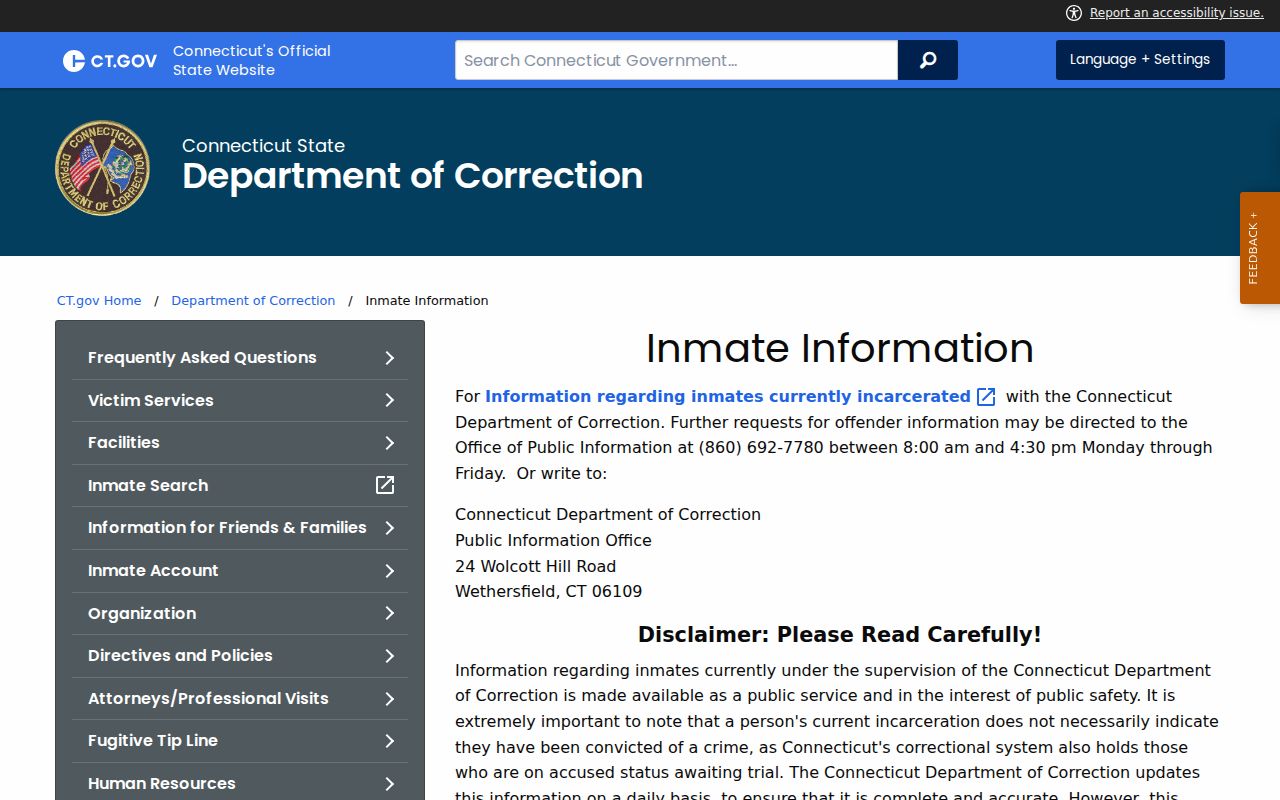
The image shows why name, inmate number, date of birth, status, location, and release fields need to stay tied to the official source and retrieval date.
Newington Business and License Records
A person can appear in a record because of an organization, trade name, license, permit, or secured filing. Connecticut eLicense searches credential type, number, person or business, status, and address, including city, state, and ZIP. Business.CT.gov provides the Secretary of the State's entity route, and its UCC resources explain a separate secured-filing path. The Town Clerk holds local trade-name and permit material. Preserve the role and filing date. An entity address or permit applicant is not a residence claim.
The official Connecticut Business Records Search landing page is the correct entity route, although the unattended inspection did not capture a complete result grid.
For a credential, use the Connecticut eLicense lookup and select the credential type before relying on a name match.
Newington Unclaimed Property Name Records
Connecticut's Treasurer describes the unclaimed-property program and maintains a free name search for assets reported after an owner could not be contacted, often after three to five years. The program can involve bank accounts, uncashed checks, refunds, securities, insurance proceeds, and other property. A result may include a name or old address and can help a family researcher decide what to verify next, but it is not a current address directory. The state will require proof of ownership or heirship.
The Treasurer's Find Your Name route leads to the official search.
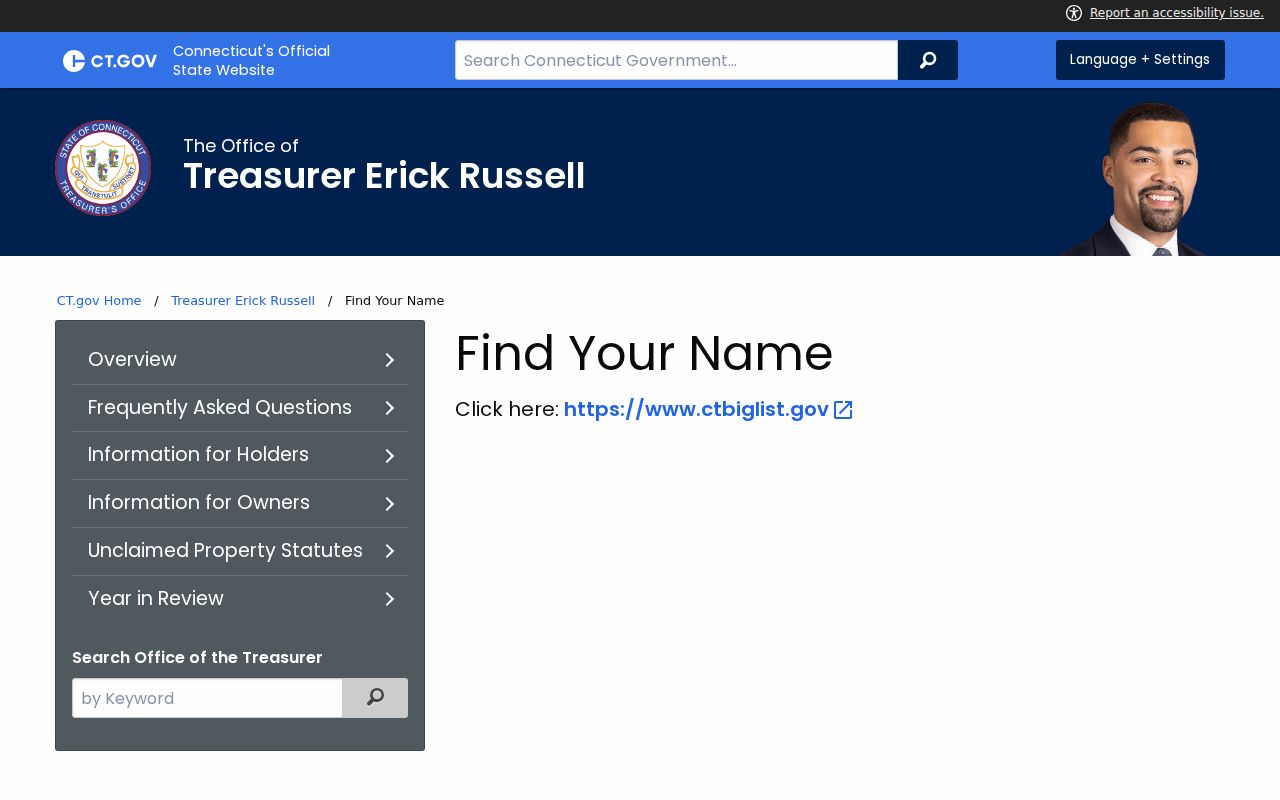
Keep the owner name, last-known address if displayed, property type, holder, claim instructions, and retrieval date. A same-name result belongs to the state claim process, not to a public profile.
Note: No complete official Newington resident directory or neighborhood-by-household roster was verified, so separate sources should remain separate in the final research notes.
What Newington Resident Records Prove
Records answer narrow questions. An assessor card can identify a taxable owner and parcel. A deed identifies parties to a transaction. A tax account identifies an account relationship. A voter entry concerns registration. A court case identifies a party role. A historic directory records a dated listing. A police, DOC, or registry entry has its own status and warning. None should be silently upgraded into a complete household profile.
| Official Newington source | Commercial data compiler |
|---|---|
| Named custodian, record role, and retrieval date | May blend dates and source types without a clear role |
| Owner, occupant, party, registrant, or address label stays defined | May merge people with the same name or repeat an old address |
| Published access, privacy, fee, and correction route | Pricing, source coverage, and correction process can vary |
| Underlying record can be requested from the custodian | Underlying source or update date may be unclear |
For example, an assessor owner, deed party, voter entry, and historic directory listing can all concern one name while proving different things. Keep the official role beside the result.
Lawful personal use. Newington public records can support family history, house history, reconnecting, and civic research. Do not use a result to stalk, harass, threaten, or harm anyone, and verify sensitive information with the official custodian.
Newington Residents in Historical Directories
The historical side of a Newington residents directory begins with place and date. The area was connected to Wethersfield from 1636, the name Newington was adopted in 1721, and the town incorporated in 1871. A pre-1871 family or property reference may therefore use Wethersfield. Later probate also changed geography: Newington belonged to the Hartford Probate District through January 7, 1975, before the current PD07 arrangement.
NARA verifies Hartford-area directory coverage including Newington in 1930-1931. The library, Connecticut Historical Society, Connecticut State Library, Library of Congress, National Archives, and Historical Society hold different pieces of the historical shelf. Newspapers, yearbooks, photographs, letters, diaries, maps, cemetery references, and house-history collections can add context when a name does not appear in a modern source. Every result needs the printed name, address, year, page or image, and repository.
The detailed collection method belongs on the Newington city directory collections page. A directory entry is a dated lead, not a current resident certification.