
What a Newington Resident Lookup Can Confirm
Newington is a Hartford County town, and a resident lookup here is a set of official leads, not a complete name-to-home roster. Each record answers a narrow question. The assessor can show a taxable owner and parcel. A deed shows recorded parties. A court result shows a public case role. A vital record confirms an event only when eligibility and jurisdiction fit. A directory or yearbook supplies a dated historical connection.
| Record | What it can confirm | Where | Access note |
|---|---|---|---|
| Property card | Taxable owner, situs, MBL, unique ID, value and sales clues | Newington Property Record Cards | Owner is not an occupant certification |
| GIS parcel | Map location, adjacent parcels, layers and property attributes | Newington MapXpress | Map context, not title proof |
| Land record | Grantor, grantee, instrument, date, volume/page, legal description | Newington Town Clerk | Name index and image dates differ |
| Court case | Party, docket, case type, entries and disposition metadata | New Britain Judicial District | Online display is not the official file |
| Probate | Estate or trust, fiduciary or heir lead, district and status | PD07 or historical Hartford District | Case role is not current residence proof |
| Vital record | Birth, death, or marriage event | Newington / Connecticut DPH | Eligibility and redactions apply |
| Directory, yearbook, newspaper | Dated address, school, family, or community lead | Library, archive, NARA, LOC | Preserve year and page |
The best conclusion is a convergence of dated roles, not one unqualified name match.
Newington Resident Records by Owner
Begin with the Newington assessor owner-name search when the name is current enough to appear in a property card. Search the last name first, then add the first name or street. If the result is broad, move to the MBL or unique ID. MapXpress can then confirm the parcel and show the layers around it. The card may display a mailing address distinct from the situs address. A mailing address receives correspondence; a situs address locates the parcel. They are not interchangeable.
Once the parcel is anchored, use the field card or Grand List for a volume/page clue. Newington's land-record index is name-based, so the address-to-party bridge saves time. When a deed matters, inspect the underlying instrument. A sales-history row is only a secondary clue. For one person's full role path, the official property search is the correct first screen.
Note: Use at least two independent fields, such as street plus middle initial or parcel plus date, before treating a name as the same person.
Newington Resident Lookup in Civil Inquiry
Newington belongs to the New Britain Judicial District for Superior Court matters. Connecticut Civil Inquiry's party search requires a last name and permits a first name, location, category, type, sort order, and name mode. The modes are Starts With, Contains, Is Equal To, and Sounds Like. Set the location to New Britain when that district is the intended starting point, but remember that a party can appear in a case with another court location.
The official Connecticut party search shows the fields to capture.
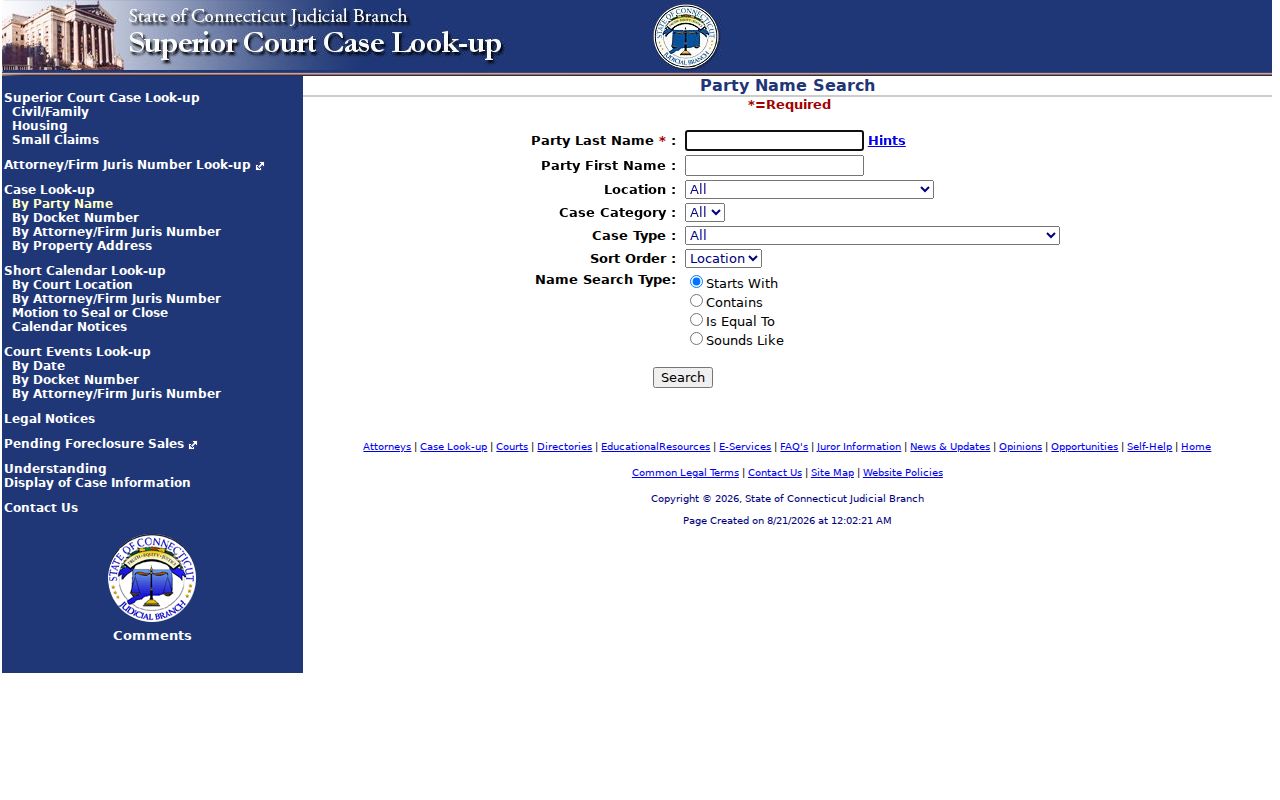
The result must be checked against court, case type, file date, party role, and case caption. A docket number is a case locator, not an address. Party appearance information identifies representation, not a residence. The Judicial Branch display guide also distinguishes pleadings, motions, events, and dispositions, each with its own date and meaning.
| Court result field | What it helps distinguish |
|---|---|
| Court location and docket number | Jurisdiction and the primary case locator |
| Case name and type | Caption, civil or family category, and subject matter |
| File, return, and last-action dates | Chronology rather than a current address |
| Party, role, and appearance | Plaintiff, defendant, party type, attorney, or self-represented status |
| Pleading, motion, event, disposition | Procedural entry, scheduled event, or outcome metadata |
Property Address Search can take a town with at least three characters, a partial street address, optional ZIP, property type, and status. It is a lead to a public docket, not a title or occupancy conclusion. The clerk's file controls when an official document is needed. A federal question follows a separate route through the District of Connecticut and, for federal case access, PACER.
Newington Resident Lookup for Vital Records
Vital records require the closest fit between event, residence, date, requester, and jurisdiction. Newington's vital statistics page starts the local trail in 1871. The state DPH registry starts July 1, 1897. For a birth, local issuance can depend on the birth location or the mother's residence. For a death, the event or the person's Newington residence at death matters. A marriage certificate follows the ceremony and residence eligibility rules.
The Newington online vital order portal presents birth, marriage, and death choices.
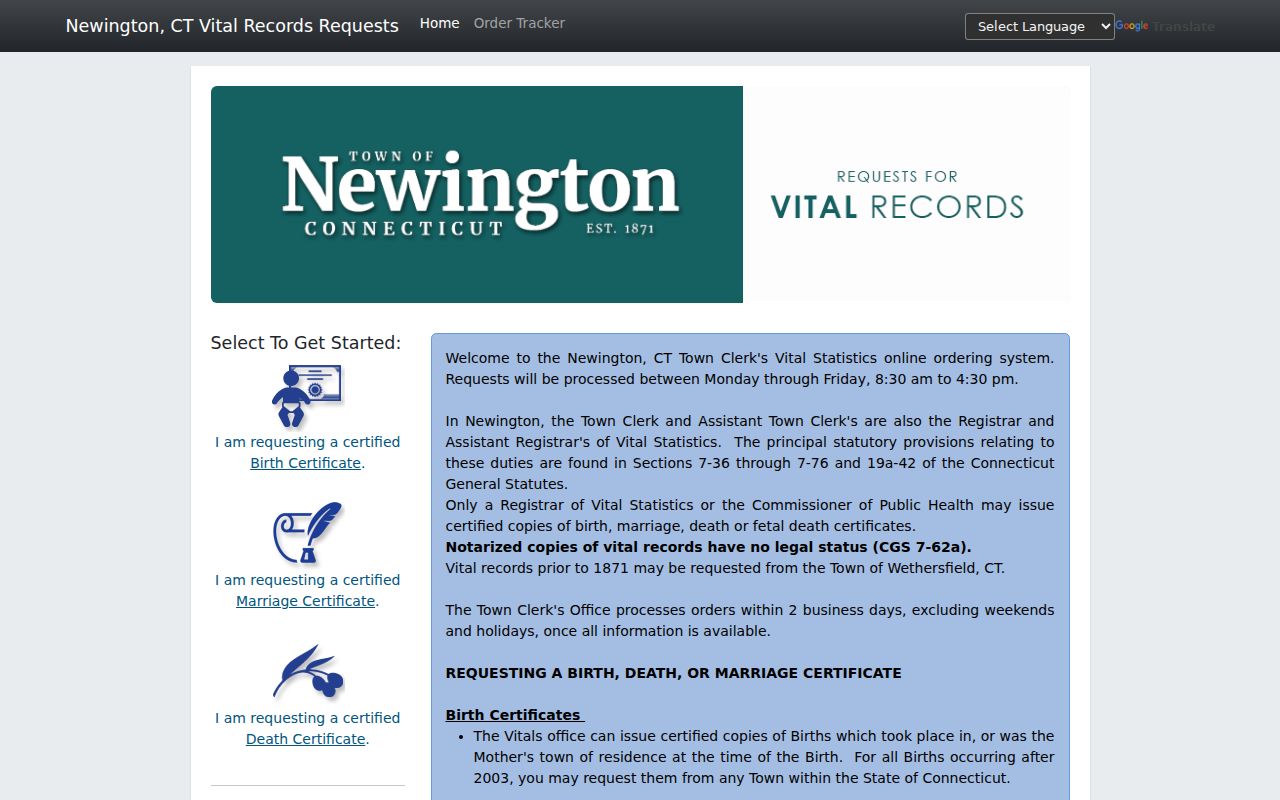
A complete form may ask for full names, event date and place, parents or spouses, requester relationship, ID, signature, contact details, payment, and delivery. The town lists $20 per certified birth, marriage, or death copy. Permitium adds separate online service, verification, and shipping charges. Birth records under 100 years are restricted, and death or marriage Social Security and administrative fields have limits.
Do not use a shared surname as a substitute for the relationship proof requested by the registrar. Divorce decrees are Superior Court records, not vital-record copies.
Newington Resident Lookup in Probate
Current Newington probate matters use PD07, the Newington Probate Court, which serves Newington, Rocky Hill, and Wethersfield. The case lookup offers Decedent's Estate and Trusts, district, Both/Open/Closed status, and last-name and first-name fields. Results may show case number, name, middle initial, type, and district. Preserve the code exactly as displayed and ask the clerk when its meaning is unclear.
Historical jurisdiction changes matter. The Connecticut State Library places Newington in the Hartford Probate District from July 1871 through January 7, 1975. A probate result can supply an estate, fiduciary, heir, inventory, will, account, or trust lead, but a named heir may live elsewhere and a district can reflect domicile, property, or another legal connection.
For an heir question, save the district, case number, case type, status, displayed name, role, and file-access route. Then ask the clerk for the underlying file or copy process. A public metadata result is not a family tree by itself.
Verifying a Newington Resident Match
The same-name problem is the main risk in a resident lookup. A search can return two people with the same surname and given name, one person with an initial change, or an entity and an individual with similar names. Verify two independent fields before combining records: middle initial, street, parcel or MBL, approximate date, organization, school, court role, spouse field, or event place. Preserve the exact spelling shown by each custodian.
- Save the original source URL, retrieval date, displayed role, and exact field values.
- Use the assessor or GIS record to anchor an address or parcel, but keep owner and occupant labels separate.
- Move to the Town Clerk name index with a volume/page clue, then compare grantor, grantee, instrument, and date.
- Use court, probate, vital, voter, license, library, or newspaper sources only when the category and jurisdiction fit.
- If records disagree, report the disagreement and ask the custodian whether it is stale, misindexed, protected, or tied to another parcel or case.
- Docket
- A court case identifier built from location, year, number, category, and sometimes a suffix.
- Index versus image
- An index helps locate a record; an image or certified copy supplies the underlying document.
- Certified copy
- A custodian-issued copy with the certification process required for the record type.
Newington Resident Safety Records
Connecticut has no Hartford County jail roster. The Department of Correction supplies a statewide current-custody search, and the Newington Police Records Division handles local report requests. DOC updates its database daily and may display name, inmate number, date of birth, status, location, admission and sentencing dates, release fields, detainers, and other descriptive fields. A field guide does not mean every value appears in every result.
The Connecticut DOC search information explains the scope.
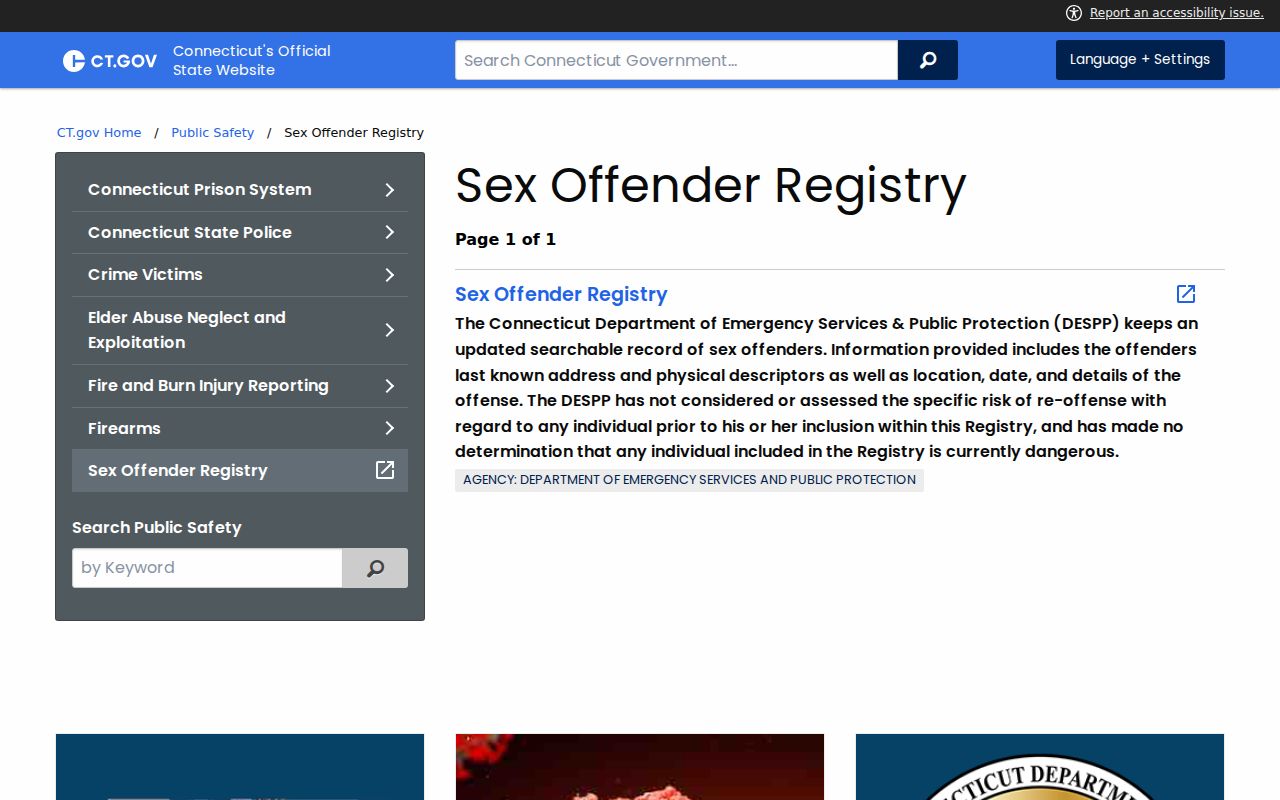
The DESPP registry can show a last-known address, physical descriptors, and offense-related fields, with a statutory warning against harassment or misuse. It is not a risk assessment or complete criminal history. Keep the source date, do not infer a current residence from an old entry, and do not expose a protected address.
Newington Resident Lookup by License
Sometimes the search goal is a role rather than a residence. Connecticut eLicense can search credential type, number, person or business, status, address, city, state, and ZIP. Business.CT.gov supplies entity records and UCC routes. Newington Town Clerk trade-name filings and parcel permits can connect an organization to a location. Newington High School yearbooks and library collections can help with a former classmate. Each result should be described as a license, organization, permit, or school connection.
For a business owner, compare the Secretary of the State entity record with a local trade name and any state credential. For a former classmate, preserve the school year, printed name, page, and repository. For a historical neighbor, use the dated directory or newspaper and then test the address against the parcel or deed chain.
A role-specific record can explain where to search next. It cannot silently become a current address statement.
Privacy Rules in a Newington Resident Lookup
Connecticut Safe at Home can give eligible participants a substitute mailing address, while the separate Voter Registry Privacy Program can limit disclosure when safety requires it. Birth records under 100 years, adoption and parentage material, juvenile matters, sealed or erased cases, certain vital fields, and DMV data have their own restrictions. An absent result is not proof that a person has no record.
The Connecticut FOIA route can request existing public records, but it does not override a specific exemption or access statute. A request should name the custodian, record, date range, and format. For correction, contact the office that holds the record. Do not try to “fix” a protected or disputed entry by publishing a different profile.
Lawful personal use. A Newington resident lookup is suitable for family history, reconnecting, heir research, and verifying a public role. Never use it to stalk, harass, intimidate, threaten, or harm a person.
When a Newington Resident Lookup Fails
Start by checking the town and court jurisdiction. Try a documented spelling or initial variant, then switch from name to parcel, street, unique ID, case number, event date, or repository catalog. A stateful portal may require a guest session or a different current destination. Older records may use Wethersfield, Hartford Probate District, a regional directory, or a paper collection.
Ask the Town Clerk, Assessor and GIS office, Registrar, court clerk, probate clerk, DPH, police Records Division, library, or Historical Society the narrow question that matches its records. Save the response and label a gap as a gap. That no-result protocol is part of a defensible resident lookup because it keeps an empty screen from becoming an unsupported conclusion.
For a street-wide question, use the Newington street directory. For a historical household, use the directory book and preserve its year and page.