
Newington City Directory Collections
Newington is a Hartford County town, but its historical directory story is regional and incomplete. The National Archives confirms Hartford-area volumes that include Newington in 1930-1931, with a 1929 lead. A FamilySearch catalog record points to New Britain volumes from 1882-1885 whose subject headings include Hartford and Newington. The Library of Congress telephone-directory guide catalogs Hartford material from the 1960s and 1970s and distinguishes telephone, street-address, and criss-cross formats. None of those sources proves a complete Newington-only run or a stable page-level scan.
| Collection lead | Years or status | Where held | Access confidence |
|---|---|---|---|
| Hartford-area directories including Newington | 1930-1931 | National Archives microfilm/catalog | Geography verified; page needs reel inspection |
| Hartford-area directory lead | 1929 | National Archives | Check Newington on the named reel |
| New Britain regional directories | 1928-1931 | National Archives | Adjacent source, not Newington-only |
| New Britain catalog volumes | 1882-83, 1883-84, 1884-85 | FamilySearch catalog and library microfilm | Catalog verified; entries need inspection |
| Hartford telephone directories | 1962/63 and 1971/72 examples | Library of Congress | Locality lead; Newington pages need checking |
| Newington local run | No complete year list verified | Lucy Robbins Welles Library / CTHS | Ask for exact holdings |
“City directory” can describe several formats. Ask for the exact type before assuming that an alphabetical volume includes every address or every household.
Where Newington Directory Shelves Begin
The Newington genealogy page points to Connecticut Historical Society material including printed genealogies, town and city directories with incomplete runs, local histories, published vital, church, and cemetery inscriptions, manuscripts, microfilm, fiche, and periodicals. Lucy Robbins Welles Library at 100 Garfield Street is the practical local starting point. Its technology and online-resource pages identify historic Newington photographs, Newington High School yearbooks, FindIT CT, ResearchIT CT, NewsBank, and genealogy and history databases.
Some databases require a library card or in-library use. The library's NewsBank route gives Newington cardholders access to local and national newspapers from home. The current listed hours are Monday through Thursday 10 a.m. to 8 p.m. and Friday and Saturday 10 a.m. to 5 p.m., with Sunday service described as seasonal. Recheck hours and catalog links before visiting.
The library and Connecticut State Library have different roles. The state guide adds early Connecticut town vital, land, and probate material on microfilm, church records, family Bibles, cemetery inscriptions, census material from 1790 through 1920, military records, naturalization indexes, immigration leads, and newspaper abstracts.
The Newington genealogy page gives a clear request route.
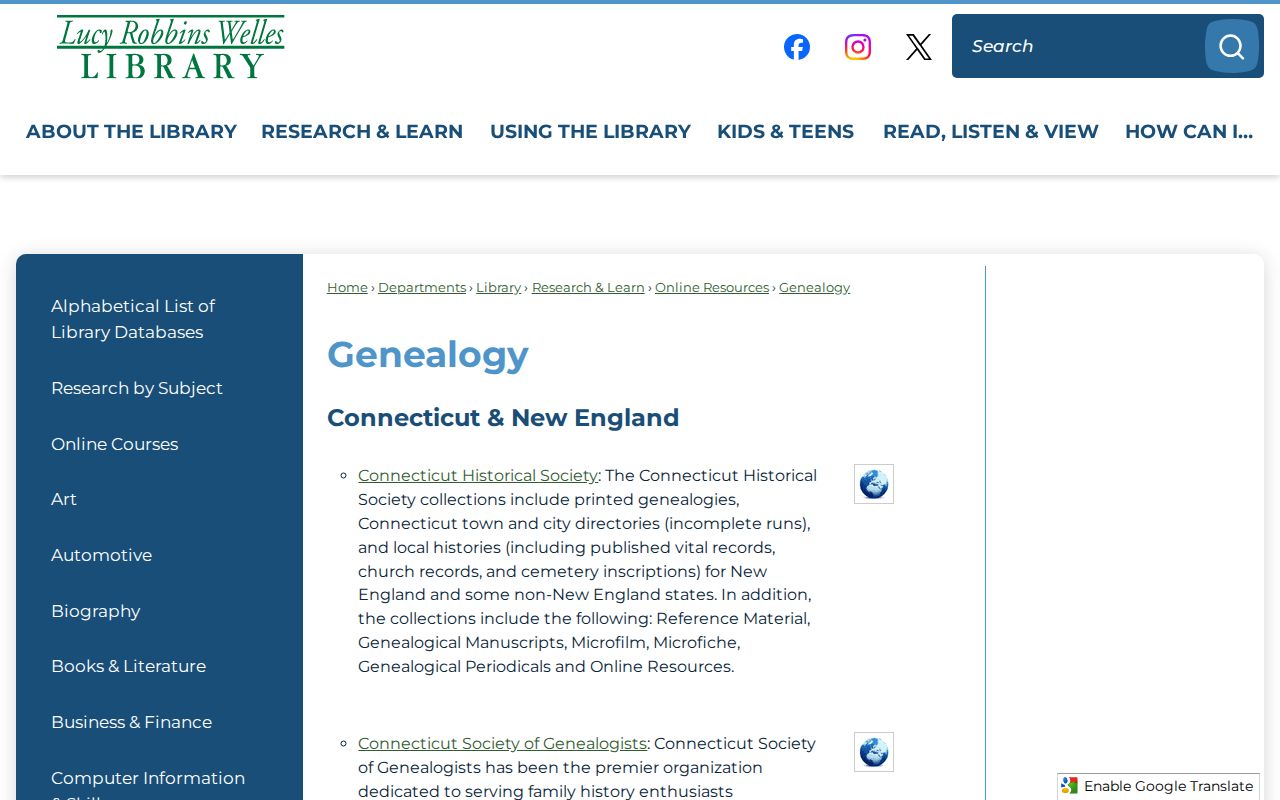
The image is a reminder to ask for a catalog item or collection description, not just a name search. Preserve the title, call number, date, page or image, access restriction, and whether the item is an index or original.
Hartford-Area Newington Directory Years
The strongest year-specific evidence comes from the National Archives' 1930 city-directory guide. It places Newington inside Hartford-area coverage for 1930-1931 alongside West Hartford, East Hartford, Wethersfield, Windsor, and Bloomfield. NARA also lists a 1929 Hartford-area lead and separate New Britain coverage for 1928-1931. A researcher should record the reel or item title before searching a name.
The National Archives coverage page explains the geography and years.
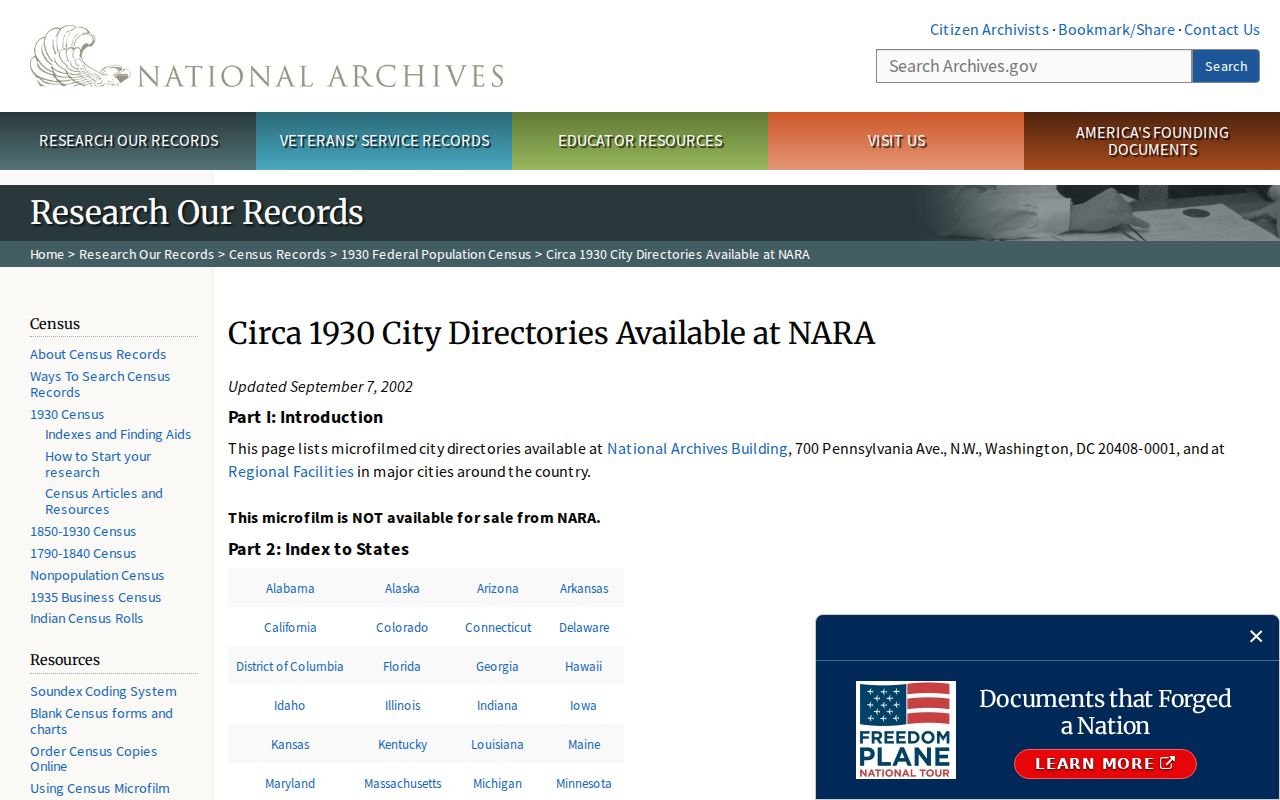
The capture supports a coverage claim, not a fabricated Newington entry. The exact page, printed address, occupation or notation, and adjacent street entries still need to be read from the reel or item.
When a volume is regional, keep the locality line with the result. Hartford coverage can include several towns, and New Britain is a separate adjacent source even when its catalog subject headings mention Newington.
Reading a Newington City Directory Entry
A directory entry makes sense only when its format is known. A typical capture may include a printed name, spouse in parentheses, occupation or business descriptor, street address, owner or renter notation, widow or boarder notation, telephone number, abbreviation key, title, publisher, year, page, reel, and repository. Do not copy every field into a current profile. Historical context is the purpose.
- Criss-cross directory
- An address-to-name volume. It can identify a listed person at a place for a given year.
- Householder index
- A finding aid arranged around a household or head of household, depending on the collection.
- Abbreviation key
- The volume's explanation for terms such as owner, renter, widow, occupation, or directory type.
- Printed address
- The address exactly as the volume presents it. It should not be silently normalized to a modern number.
Compare the same street section with its alphabetical name index. A spelling change, initial, spouse field, or address move may distinguish two people with the same surname. A telephone directory, business directory, and street-address directory can each place a person in a different context.
| Entry element | What to preserve |
|---|---|
| Printed name | Spelling, initials, spouse or household notation |
| Address | Street wording, number, unit, and any printed owner or occupant mark |
| Descriptor | Occupation, business, telephone, widow, or boarder notation only when relevant |
| Directory metadata | Type, title, publisher, year, page, reel or item, and repository |
| Neighboring entries | Street-section context that helps test a spelling or address change |
Because no stable Newington page-level scan was captured, this is a capture inventory, not a fabricated sample entry.
Newington Directory Requests by Year
Repository staff can search more effectively when the request is narrow. Start with a person or house name, street, approximate period, and record type. Ask whether the item is alphabetical, street-address, telephone, business, or criss-cross. If a library card or on-site database is required, say whether that access is available.
| Repository | Prepare these fields |
|---|---|
| Lucy Robbins Welles Library | Person or house, street, approximate years, record type, library-card status |
| Connecticut State Library | Town, record type, date range, family or street, reel or catalog identifier |
| Newington Historical Society | Address, prior family, period, photograph, document, map, or house-history request |
| Library of Congress | Directory type, Hartford/Newington locality, exact year |
| National Archives | Hartford-area directory, 1930 or 1931, name or address |
| FamilySearch catalog | Place, title, author, year, online-availability filter, viewing restriction |
Keep the repository response even when it says no item was found. An incomplete run is useful evidence when the gap is labeled as a collection limit rather than presented as a missing person.
Newington Newspapers as Directory Companions
The Library of Congress catalogs The town crier of Newington for 1959-1971 with a weekly frequency. It can lead to community announcements, marriages, deaths, organizations, and street context. The catalog record does not establish a complete searchable obituary index. Use a date or event request through the library or archive instead of assuming that every name is searchable.
NewsBank and the Hartford Courant archive add broader newspaper routes. The documented Hartford Courant archive covers 1764-1992 through the library resource page. A newspaper mention should be preserved with date, page or database record, publication, and event. It can mark a move, death, marriage, civic role, or school connection, but it is not a deed or present residence certificate.
Pair a newspaper event with a directory year, map, census, land record, probate file, or Historical Society collection when the household trail matters.
Wethersfield and Newington Place Names
Newington's older people and address records may use a different place label. Historical Society material says the area was used by Wethersfield from 1636, early names included Pipestaves Swamp, Cow Plain, and West Farms, the Newington name was adopted in 1721, and the town incorporated in 1871. A directory entry or church record from before incorporation may therefore belong in a Wethersfield search path.
Probate has another date boundary. Newington was in the Hartford Probate District from July 1871 through January 7, 1975. Current matters use Newington Probate Court PD07. Vital records begin locally in 1871, while the statewide DPH registry begins in 1897. Date and jurisdiction should sit beside every historical directory result.
- 1636 - Wethersfield-associated use gives the earliest place context in the reviewed local history.
- 1721 - The Newington name appears in the town's historical account.
- 1871 - Incorporation marks the local starting point for Newington vital and genealogical records.
- 1975 - The current probate boundary follows the historical Hartford Probate District period.
Historic maps from 1869 and 1934 can help with place context, but they do not convert a printed address into a current parcel by themselves.
Using Newington City Directories for Family History
Directory research works best as a sequence of small comparisons. Choose two or more years. Search the surname index and then the street section. Write down the exact spelling, spouse or household notation, address, and source type. Compare a matching census year when one is available. Then test the name against a deed, probate matter, obituary, cemetery inscription, school yearbook, or newspaper event.
- Select a starting year and a later year, and state whether the volume is city, telephone, street-address, business, or criss-cross.
- Capture the printed name and address exactly, including initials, abbreviations, spouse notation, owner or renter mark, and page.
- Check a federal census or a second directory year for household composition and address continuity.
- Use the Newington assessor, GIS, deed, probate, or map route only when the legal or parcel crosswalk supports it.
- End with a dated event such as an obituary, marriage notice, move, sale, or cemetery record, and record the repository.
When the question turns from a historical household to one person's modern record roles, use the Newington resident lookup without erasing the directory's date.
What a Newington City Directory Does Not Prove
A city directory listing is evidence that a name was printed in a particular volume. It does not prove present residence, ownership, family relationship, or continued occupancy. A directory may include renters, boarders, business contacts, a widow notation, or a telephone subscriber. It may also follow a regional exchange or an old street spelling.
Use a dated role. Newington city directories are valuable for family history and house history. Keep the year, page, source type, and repository attached to the name, and confirm any sensitive modern detail with the proper custodian.
Older records can be incomplete. The reviewed local sources did not verify a complete Newington-only publisher and year inventory, a complete obituary index, or an exact reverse-directory run. Reporting those gaps is more accurate than filling them with a guess.