
Sources for Previous Residents of a Newington Address
Newington is in Hartford County, but a previous-residents search needs more than one era. The assessor starts the current parcel trail. The Town Clerk index connects names to recorded documents. Regional directories can place a household at an address for a year. Census and newspaper sources add family or event context. Probate and cemetery material can mark an ending or move. The table keeps each source's time range and meaning visible.
| Source | Years or cutoff | Where held | What it shows |
|---|---|---|---|
| Assessor card and GIS | Current card; map updated July 2026, property data nightly | Newington Property Record Cards / MapXpress | Parcel, owner display, values, sales and map clues |
| Town Clerk land index | Computer index from 1976; images displayed from 03/21/1985 | Newington Town Clerk / Town Clerks' Portal | Recorded parties, documents, dates, volume/page |
| Hartford-area directories | 1930-1931 verified lead; 1929 lead | National Archives | Dated name and address entries including Newington coverage |
| New Britain catalog directories | 1882-83 through 1884-85 | FamilySearch catalog / library microfilm | Regional lead with Newington subject heading |
| Newington newspaper | The town crier, 1959-1971 | Library of Congress / library routes | Community notices and dated events |
| Maps and local collections | 1869 and 1934 maps; collection-specific | Town map library / Historical Society | Place continuity, photographs, papers, buildings and context |
The exact year, page, repository, and source type belong beside each name. A gap is part of the timeline, not permission to fill it.
Newington Previous Residents in Deed Records
Newington's land index is not a street index. The Town Clerk FAQ says the computer index is filed by name and recommends using the Grand List or assessor field card for a volume/page reference when an address is known. The portal displayed Newington image availability from March 21, 1985, while the computer index reaches back to 1976 per the FAQ. Earlier books or images may require an office, microfilm, or archive route.
The official Connecticut Town Clerks' Portal exposes the account, guest, image, and subscription path.
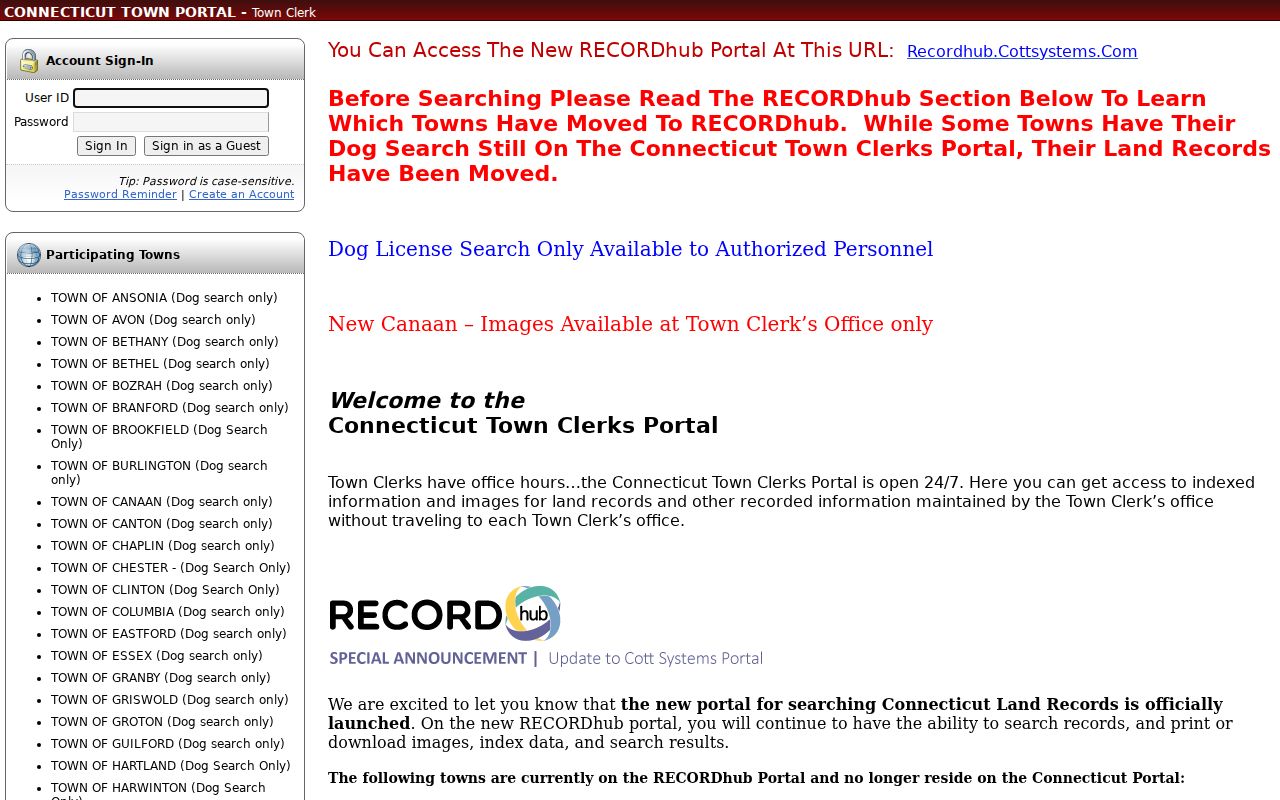
The login capture is a workflow reference, not a live Newington transaction. A permitted guest session still needs to produce a field-only row before any deed number or image claim is published. Keep the town, grantor, grantee, instrument type, date, volume/page, and image status together.
Land-record images can be printed online at $1 per page under the town schedule. A certified copy, map, recording, or transfer can have a different fee. Recheck the current clerk schedule before ordering.
Tracing Newington Previous Residents Backward
A chain of title is the sequence of recorded interests in a parcel. It is a legal ownership trail, not a list of everyone who lived in the house. Begin with the current assessor owner and the volume/page clue, then move through the Town Clerk index in the direction that exposes the earlier party.
- Save the current card's owner display, situs address, MBL or unique ID, legal description clue, and map date.
- Search the current owner as grantee, the person or entity receiving the interest, and check the purchase date and instrument.
- Read the grantor, the person or entity conveying the interest, and search that party as grantee for the prior purchase.
- Repeat with spelling variants, former names, corporate names, releases, mortgages, and maps when the chain changes shape.
- When the online image or index cutoff is reached, ask the Town Clerk or archive for the earlier book, microfilm, or copy route.
- Grantor
- The party conveying an interest in a recorded transaction.
- Grantee
- The party receiving an interest in that transaction.
- Chain of title
- The connected sequence of recorded ownership interests for a parcel.
- Legal description
- Recorded language, map, subdivision, or other description that can identify land when an old street number changes.
Confirm each link with date, instrument, legal description, and parcel evidence. A property-card sales row is a clue, not the underlying instrument.
Newington Previous Residents and Maps
Newington's Static Map Library includes a current Street Index, Street Listings by District, historic maps, cemeteries, schools, voting districts, land use, and zoning. The 1869 and 1934 maps can show a route, landmark, farm, cemetery, or place label near an older record. They do not supply a direct modern number conversion.
The Newington Static Map Library is the source for the map files.
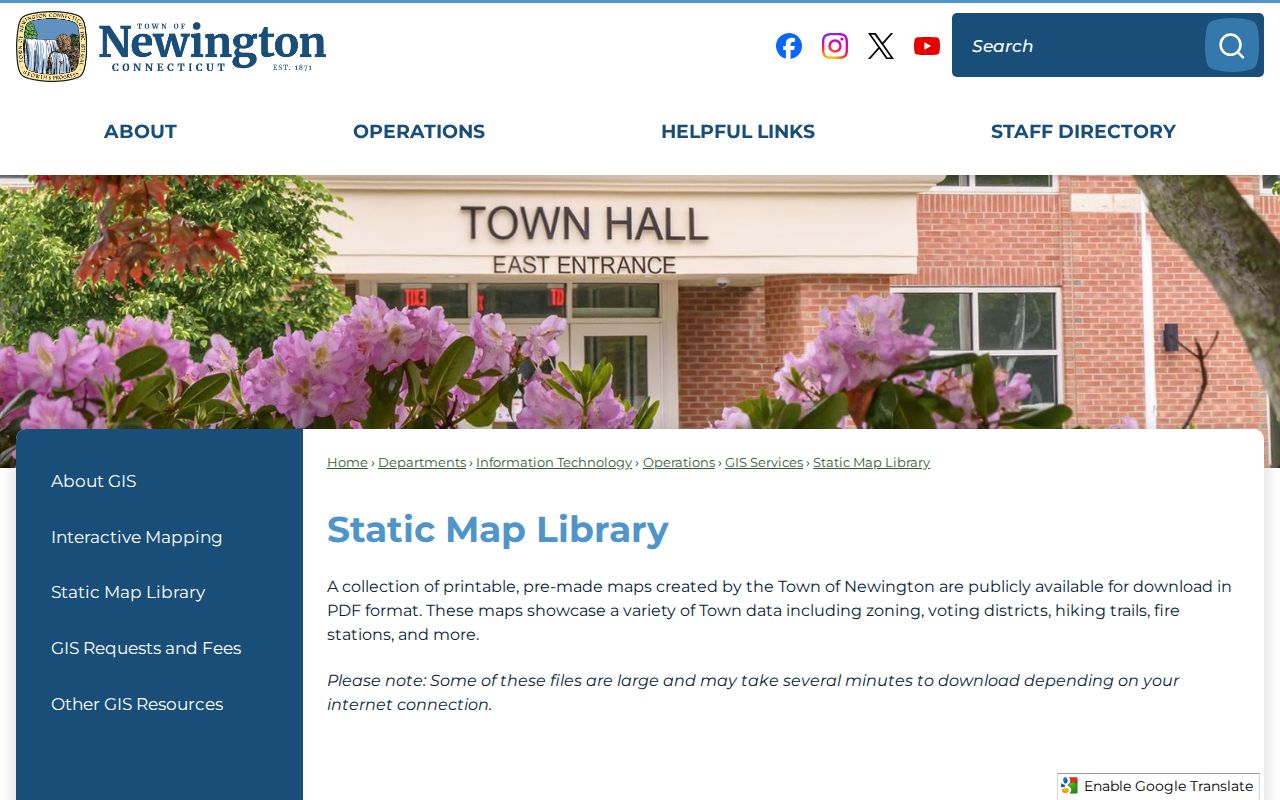
Keep the map title, print date, page, grid, and layer. Use legal description, volume/page, field card, and parcel clues before matching a historical road to a current address.
Newington's place history also reaches backward to Wethersfield. The area was associated with Wethersfield from 1636, took the Newington name in 1721, and incorporated in 1871. A pre-incorporation reference may use Wethersfield rather than Newington.
Newington Previous Residents in Archives
Legal documents often leave a house's human story thin. The Newington genealogy route points to Connecticut Historical Society directories, local histories, vital, church, and cemetery inscriptions, genealogical manuscripts, microfilm, fiche, and periodicals. Lucy Robbins Welles Library adds historic photographs and Newington High School yearbooks. The Connecticut State Library adds town records, census, church, cemetery, newspaper, military, naturalization, and immigration material.
Newington Historical Society collections include photographs, tintypes, slides, handwritten documents, diaries, account books, maps, architectural drawings, letters, business papers, personal papers, artifacts, and books about local citizens. Its Kellogg-Eddy House and Enoch Kelsey House pages show how a property can connect to a family, building, cemetery, or civic history. The society's research contact is 860-666-7118 at 679 Willard Avenue.
The Connecticut State Library History and Genealogy guide is the statewide archive and microfilm route.
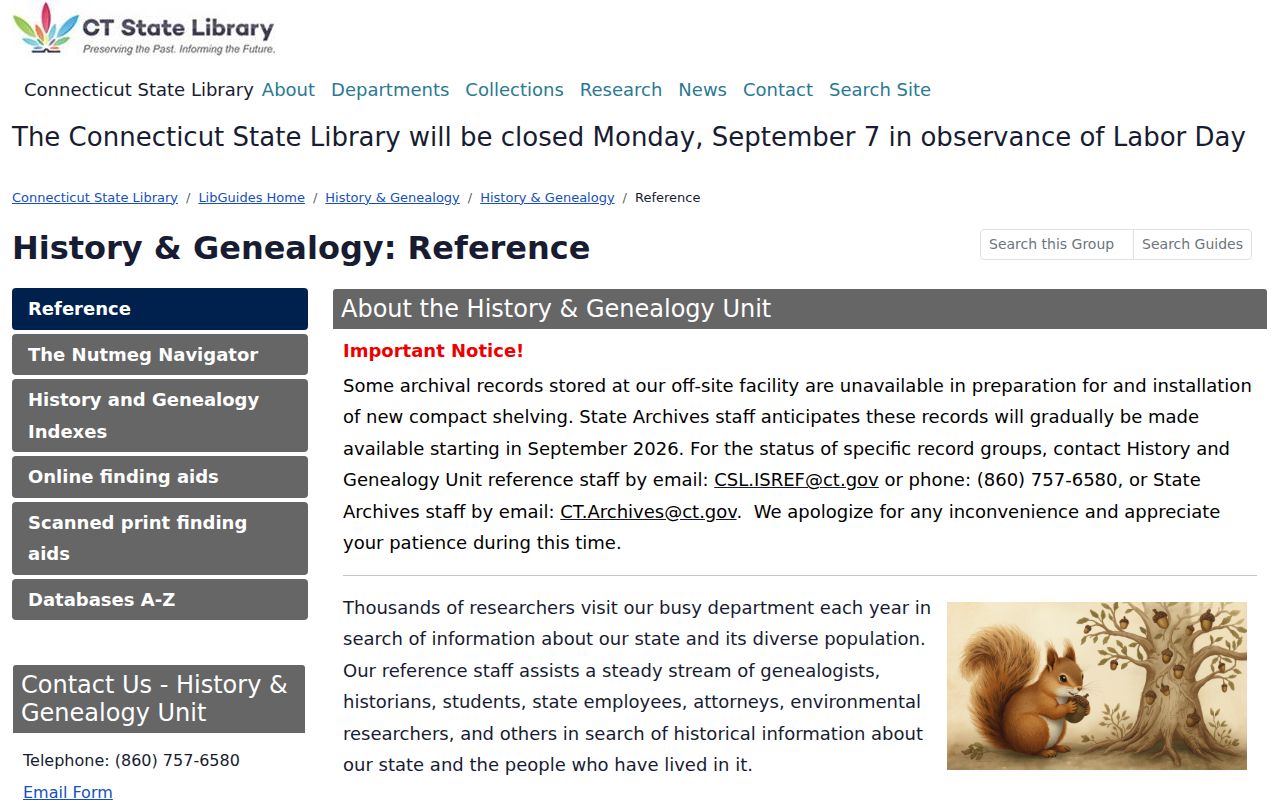
The guide is broad rather than Newington-only. Request the town, record type, date range, family or street, and reel or catalog identifier, then keep whether the result is an index, transcription, or original.
Prepare a request with the street, prior owner or family, approximate period, and collection type. Preserve the repository description or accession reference instead of copying a private paper into a name profile.
Newington Directory Years and Census Pairings
NARA verifies Hartford-area directory coverage including Newington for 1930-1931. The Library of Congress guide explains how to request city, telephone, street-address, business, and criss-cross directories. A FamilySearch catalog record lists New Britain volumes from 1882-1885 with a Newington subject heading, but the exact Newington entries need inspection. The local library and CTHS do not publish a complete Newington-only year and publisher list in the reviewed pages.
Pair a directory year with the nearest available census. Capture the printed name, spouse field, address, occupation only when relevant, owner or household notation, page, reel, repository, and abbreviation key. Then compare the same street or surname in a second year. A directory entry shows what was printed for that year; a census and a deed have different source roles.
- Choose the directory year and type, and note its locality coverage.
- Search the surname index and street section, then save the exact entry and neighbors on the page.
- Compare the matching census year, map, newspaper, or school yearbook when available.
- Test the name against the parcel and deed chain, using a date and role label.
For the collection itself, use the Newington city directory page. The backward trail here stays with one address.
Newington Previous Residents in Newspapers
The town crier runs from 1959 through 1971 in the Library of Congress record. NewsBank and the Hartford Courant archive offer additional dated newspaper routes. An obituary, marriage notice, school item, civic announcement, or business mention can mark when a person was connected with an address. It does not prove title or continued residence.
Probate can supply an estate, fiduciary, heir, inventory, will, or trust lead. Newington current probate is PD07, while historical matters before January 7, 1975 may be in Hartford Probate District. The event date and district should be recorded before a file is requested. Cemetery and church material can add a place or family connection.
Use a dated event to end or explain a timeline. Do not use an obituary or probate name to infer a living person's current address.
Newington Previous Residents and House History
The Historical Society's Kellogg-Eddy House was built in 1808 by Captain Martin Kellogg, occupied by that family until 1913, renovated in 1928, and purchased by the Town in 1976. Part of the former farm became West Meadow Cemetery. The Enoch Kelsey House is a 1799 farmhouse and tinsmith property tied to Enoch and David Kelsey, later moved to a Main Street site and preserved with historic interior work.
These examples are not a shortcut to a private household list. They show how a house history can join recorded land, architecture, family papers, cemetery geography, maps, and civic use. For another address, request the collection description and verify the date and repository before attaching a person to the building.
Public civic parcels such as the 200 Garfield campus are safer demonstration records than a private home. Use a public sample when explaining the fields in an address history.
Newington Previous Residents Versus Owners
A past owner is a recorded party. A past occupant is a dated directory, newspaper, census, yearbook, or other source subject. A taxpayer is attached to an account. A permit applicant is attached to a project. A probate heir is attached to a legal file. These roles can overlap, but one cannot be silently substituted for another.
When a name appears in two sources, record the source dates and the independent fields that connect them. If the address changed, use the legal description, map, parcel, volume/page, and place name. If the source only says that a person was part of an event, leave the address conclusion open.
Note: The safest prior-resident timeline includes a source, date, page or identifier, role, and confidence note for every line.
Privacy Limits on Newington Previous Residents
Historical research can still touch living people. Safe at Home can replace an eligible participant's physical address with a substitute mailing address. The Voter Registry Privacy Program can limit release of a protected name or address. Birth, adoption, juvenile, sealed, erased, DMV, and other sensitive records have separate rules. Do not try to recover a protected address by combining a map, tax account, voter clue, or old directory.
Lawful house history. Previous residents research in Newington is for family history, property history, reconnecting, and personal curiosity. Do not use a timeline to stalk, harass, intimidate, threaten, or harm any person.
The backward trail is strongest when it stops at the point the record no longer supports a conclusion. A documented gap is better than an invented occupant.